Why More Clients Means More Chaos (And How to Scale Without It)
Why More Clients Means More Chaos (And How to Scale Without It)
Written by

Jonny Stuart

Traditional agency tools create exponential complexity as you grow, turning doubled client counts into quadrupled coordination chaos. The problem isn't scaling itself, it's the multiplication trap: fragmented tools force you to scale overhead instead of capacity.
Three traps drive this: tool multiplication (status checks balloon from manageable to hours daily) communication explosion (team coordination overhead multiplies exponentially), and margin erosion mystery (revenue grows but profit barely keeps pace). The solution: unified systems that scale coordination capacity not coordination time.
In this post
Section
January 2024: 8 clients, working 45-hour weeks, loving it.
…July 2024: 15 clients, working 65-hour weeks, snapping at the team, missing important moments with family.
Revenue nearly doubled. Happiness tanked. Something was deeply broken.
This isn't a people problem or a process problem. It's a complexity accumulation problem. Your tools create exponential overhead as you scale, not linear growth. Below, we break down the three traps that turn healthy growth into chaos—and show how to scale coordination capacity instead of coordination time.
Why Does Doubling Clients Quadruple Chaos?
What you think happens when you grow:
5 clients → 10 clients = 2× the work, 2× the revenue, 2× the profit. Simple math.
What actually happens:
5 clients → 10 clients = exponentially more coordination, constant context-switching, more tools to check daily, more places information hides. Your revenue doubles. Your operational complexity explodes.
Traditional tools create exponential complexity. Every new client adds projects in your PM tool, time tracking codes, Slack channels, folder structures across three platforms, budget spreadsheets, and new context you need to hold in your head.
Fragmented Stack Complexity = (Clients × Projects × Team × Tools × Channels) ÷ Manager Bandwidth
As any variable increases, complexity grows exponentially because everything is interconnected across disconnected systems. At 5 clients with 8 people and 4 tools, you're managing maybe 15-25 coordination points weekly. At 15 clients with 18 people and 8 tools, you're managing well over 100 coordination points.
Most agencies hit the wall between 10-15 clients. Not because they lack talent. Because their tools can't scale coordination without scaling coordination time.
The Three Traps That Kill Growth
Trap #1: The Multiplication Trap
Every new client forces you to multiply your tools and rituals.
Time cost breakdown:
5 clients: 2-3 hrs/week on status checks
10 clients: 6-8 hrs/week
15 clients: 10-15 hrs/week
What was manageable background work becomes a part-time job. The headspace cost hits harder: you can't hold it all in your head anymore. Every morning starts with "What am I forgetting?"
A dev agency founder running a 12-person team: "At 7 clients, I knew every project status in my head. At 14 clients, I needed 45 minutes each morning just to REMEMBER where everything was across ClickUp, Notion, Harvest, and Slack."
The tools you added to "stay organized" became the thing stealing your time.
Trap #2: The Communication Explosion
Team growth creates exponential communication overhead in fragmented systems.
The math of team communication:
5 people = 10 potential communication pairs
10 people = 45 potential pairs
15 people = 105 potential pairs
With fragmented tools, each pair needs to align across multiple sources of truth. The coordination cost compounds:
5-person team: 8-10 hrs/week organizational overhead
15-person team: 20-25 hrs/week organizational overhead
At 5 clients, you're a player-coach. At 15 clients, you're a full-time translator between tools, team members, and clients.
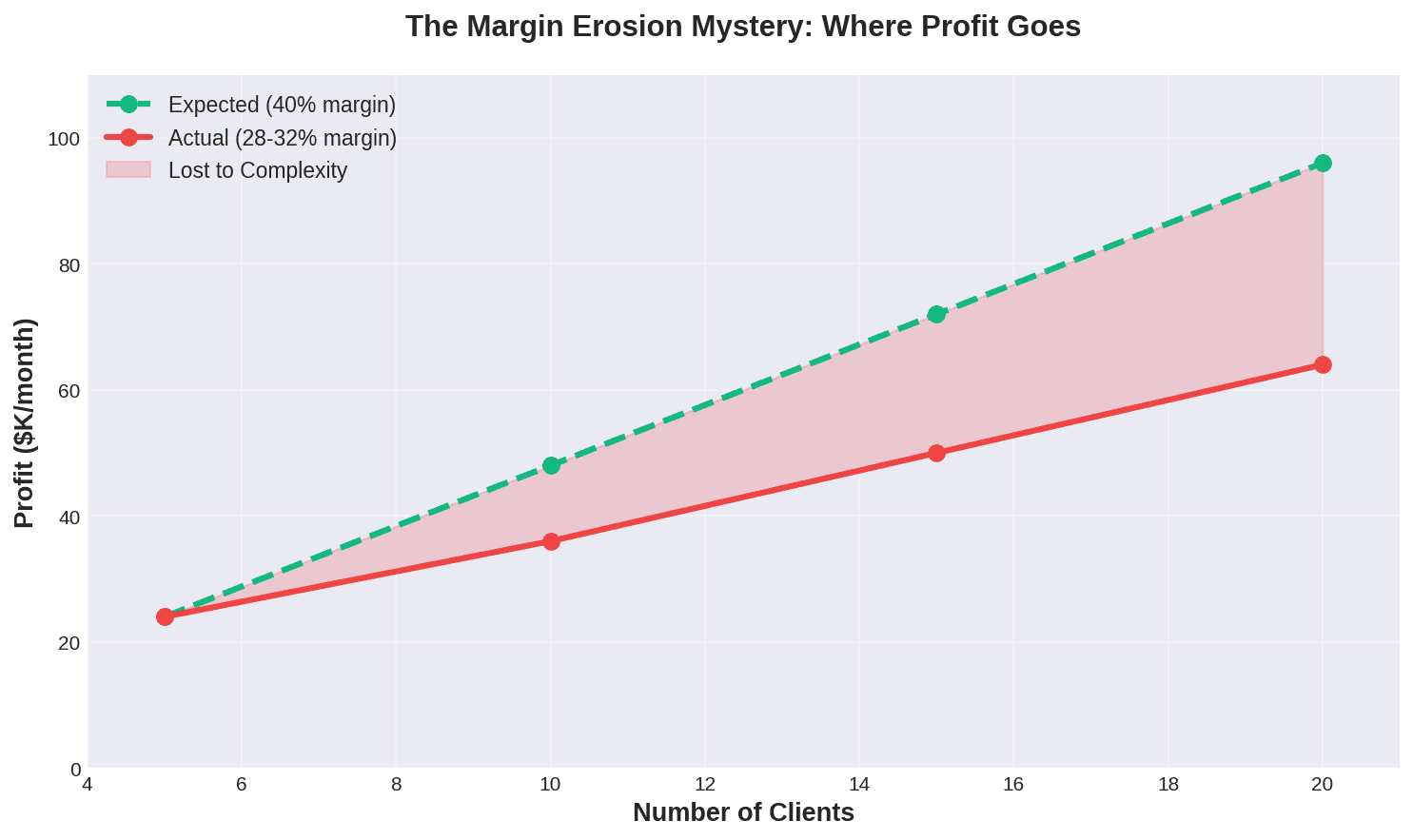
Trap #3: The Margin Erosion Mystery
Revenue grows. Profit doesn't grow proportionally. You can't figure out why.
Expected pattern: 5 clients @ 40% margin → 10 clients @ 40% margin = doubled profit
Actual pattern: 5 clients @ 40% margin → 10 clients @ 28-32% margin = profit barely increased
The invisible margin killers all stem from complexity:
Senior people spending 30-40% of time on coordination instead of billable work
Rework from miscommunication across information silos
Scope creep invisibility across multiple projects
Inefficient allocation because you can't see capacity and margins clearly
Founder spending 25-35 hrs/week on operations instead of strategy
Why Traditional "Solutions" Don't Work
Most agencies try four fixes. All fail because they accept complexity as inevitable:
"Just hire more people" → More people = exponential coordination. Each hire requires 10-15 hrs onboarding across fragmented tools. Coordination overhead eats the productivity gain.
"Systematize your processes" → You systematize WITHIN each tool, but the tools don't talk. You've documented complexity, not eliminated it.
"Add more project management discipline" → Discipline doesn't fix structural fragmentation. More status meetings don't solve information silos.
"Integrate your tools better" → Integrations break, require maintenance, and still require you to be the human middleware.
Here's what competitors like Productive, Teamwork, and Scoro won't tell you: they all assume complexity is inevitable. Productive tells you to "build better workflows." Teamwork says "use our templates." Scoro suggests "add more automations."
All help you manage complexity prettier. None ask: what if we eliminated it entirely?
How Do You Scale Without Scaling Overhead?
Unified systems change the scaling equation:
Unified System Scaling = Clients × Projects × Team ÷ Single Source of Truth
As clients grow, complexity stays manageable because everything lives in one intelligent system that handles coordination.
130-180 hours weekly that could go to billable work, client development, strategic thinking or honestly, just not working weekends.
What This Looks Like in Practice
Client onboarding:
Traditional stack: 2+ hours setup per client (ClickUp, Harvest, Notion, Slack, spreadsheets, team briefing)
Unified system: 5 minutes (AI auto-generates structure, assigns team, sets up tracking)
Time saved per client: Nearly 2 hours
Weekly status:
Traditional stack: 12+ organizational hours weekly (manager assembles from 6 tools, team hunts for context)
Unified system: Under 30 minutes weekly (real-time dashboard, team self-serves)
Time saved weekly: 10+ hours
What Growth Should Feel Like
Traditional scaling:
Year 1: 5 clients, 45-hour weeks, energized
Year 2: 12 clients, 58-hour weeks, stressed
Year 3: 18 clients, 65-hour weeks, burned out
Leverage scaling:
Year 1: 5 clients, 45-hour weeks, energized
Year 2: 12 clients, 42-hour weeks, excited
Year 3: 20 clients, 45-hour weeks, strategic
The difference: You scaled intelligence and coordination capacity FIRST through a unified system, not headcount and hours worked.
Key Takeaways
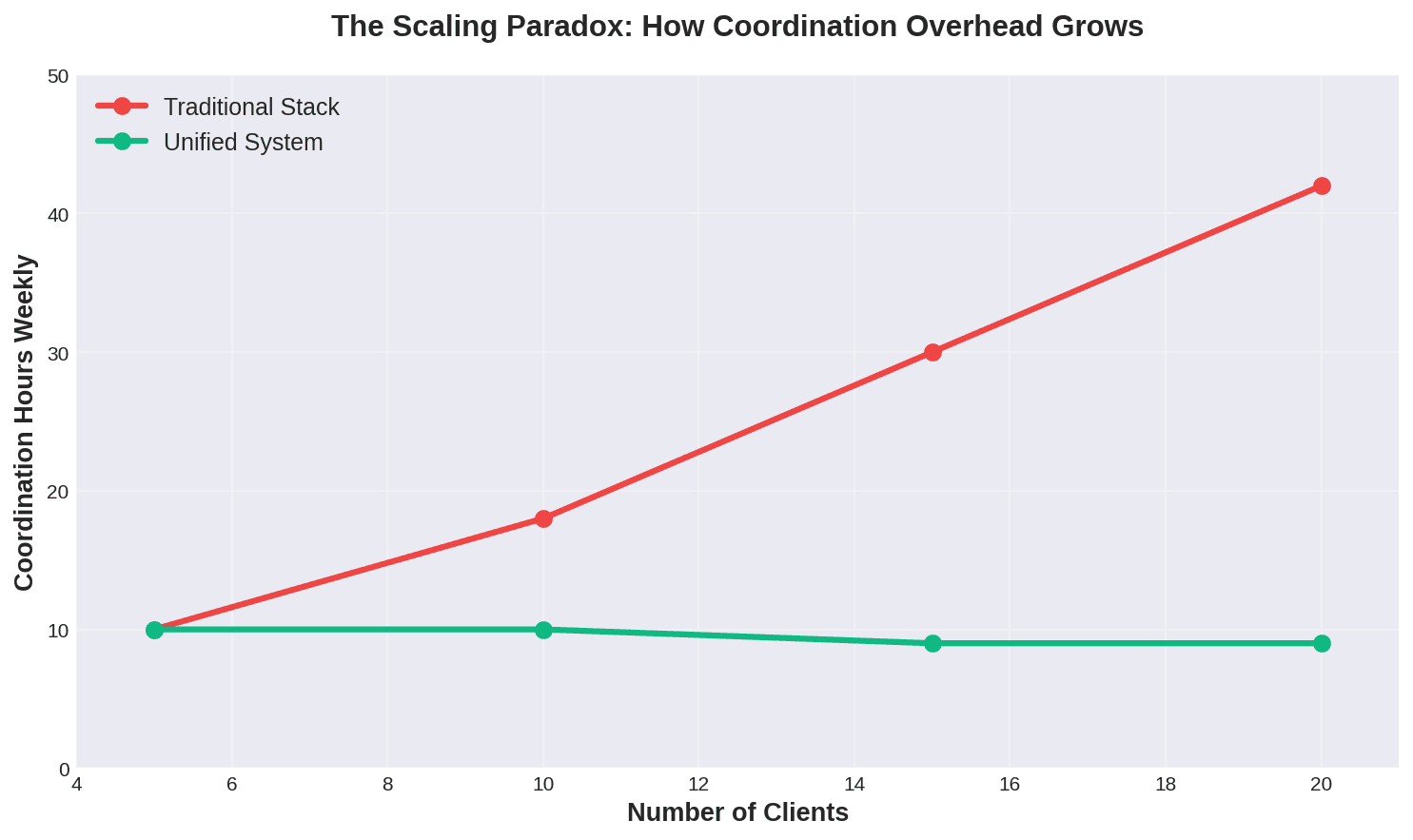
The Scaling Paradox: Traditional agency tools create exponential complexity as you grow. More clients shouldn't mean more chaos, but with fragmented tools, it always does.
Three Traps Destroy Growth: Multiplication Trap (status checks balloon from 2-3 to 10-15 hrs/week), Communication Explosion (team coordination multiplies overhead exponentially), and Margin Erosion Mystery (revenue grows but profit barely keeps pace).
Unified Systems Scale Differently: At 15 clients, traditional stacks cost 175-210 organizational hours weekly. Unified systems: 26-46 hours. That's 130-180 hours reclaimed weekly.
You Don't Have a Scaling Problem: You have a complexity accumulation problem. Your fragmented tools create it. Consolidation eliminates it.
Growth Should Feel Like Leverage: Traditional scaling means 65-hour weeks at 18 clients. Leverage scaling means 45-hour weeks at 20 clients and enjoying what you built.
January 2024: 8 clients, working 45-hour weeks, loving it.
…July 2024: 15 clients, working 65-hour weeks, snapping at the team, missing important moments with family.
Revenue nearly doubled. Happiness tanked. Something was deeply broken.
This isn't a people problem or a process problem. It's a complexity accumulation problem. Your tools create exponential overhead as you scale, not linear growth. Below, we break down the three traps that turn healthy growth into chaos—and show how to scale coordination capacity instead of coordination time.
Why Does Doubling Clients Quadruple Chaos?
What you think happens when you grow:
5 clients → 10 clients = 2× the work, 2× the revenue, 2× the profit. Simple math.
What actually happens:
5 clients → 10 clients = exponentially more coordination, constant context-switching, more tools to check daily, more places information hides. Your revenue doubles. Your operational complexity explodes.
Traditional tools create exponential complexity. Every new client adds projects in your PM tool, time tracking codes, Slack channels, folder structures across three platforms, budget spreadsheets, and new context you need to hold in your head.
Fragmented Stack Complexity = (Clients × Projects × Team × Tools × Channels) ÷ Manager Bandwidth
As any variable increases, complexity grows exponentially because everything is interconnected across disconnected systems. At 5 clients with 8 people and 4 tools, you're managing maybe 15-25 coordination points weekly. At 15 clients with 18 people and 8 tools, you're managing well over 100 coordination points.
Most agencies hit the wall between 10-15 clients. Not because they lack talent. Because their tools can't scale coordination without scaling coordination time.
The Three Traps That Kill Growth
Trap #1: The Multiplication Trap
Every new client forces you to multiply your tools and rituals.
Time cost breakdown:
5 clients: 2-3 hrs/week on status checks
10 clients: 6-8 hrs/week
15 clients: 10-15 hrs/week
What was manageable background work becomes a part-time job. The headspace cost hits harder: you can't hold it all in your head anymore. Every morning starts with "What am I forgetting?"
A dev agency founder running a 12-person team: "At 7 clients, I knew every project status in my head. At 14 clients, I needed 45 minutes each morning just to REMEMBER where everything was across ClickUp, Notion, Harvest, and Slack."
The tools you added to "stay organized" became the thing stealing your time.
Trap #2: The Communication Explosion
Team growth creates exponential communication overhead in fragmented systems.
The math of team communication:
5 people = 10 potential communication pairs
10 people = 45 potential pairs
15 people = 105 potential pairs
With fragmented tools, each pair needs to align across multiple sources of truth. The coordination cost compounds:
5-person team: 8-10 hrs/week organizational overhead
15-person team: 20-25 hrs/week organizational overhead
At 5 clients, you're a player-coach. At 15 clients, you're a full-time translator between tools, team members, and clients.
Trap #3: The Margin Erosion Mystery
Revenue grows. Profit doesn't grow proportionally. You can't figure out why.
Expected pattern: 5 clients @ 40% margin → 10 clients @ 40% margin = doubled profit
Actual pattern: 5 clients @ 40% margin → 10 clients @ 28-32% margin = profit barely increased
The invisible margin killers all stem from complexity:
Senior people spending 30-40% of time on coordination instead of billable work
Rework from miscommunication across information silos
Scope creep invisibility across multiple projects
Inefficient allocation because you can't see capacity and margins clearly
Founder spending 25-35 hrs/week on operations instead of strategy
Why Traditional "Solutions" Don't Work
Most agencies try four fixes. All fail because they accept complexity as inevitable:
"Just hire more people" → More people = exponential coordination. Each hire requires 10-15 hrs onboarding across fragmented tools. Coordination overhead eats the productivity gain.
"Systematize your processes" → You systematize WITHIN each tool, but the tools don't talk. You've documented complexity, not eliminated it.
"Add more project management discipline" → Discipline doesn't fix structural fragmentation. More status meetings don't solve information silos.
"Integrate your tools better" → Integrations break, require maintenance, and still require you to be the human middleware.
Here's what competitors like Productive, Teamwork, and Scoro won't tell you: they all assume complexity is inevitable. Productive tells you to "build better workflows." Teamwork says "use our templates." Scoro suggests "add more automations."
All help you manage complexity prettier. None ask: what if we eliminated it entirely?
How Do You Scale Without Scaling Overhead?
Unified systems change the scaling equation:
Unified System Scaling = Clients × Projects × Team ÷ Single Source of Truth
As clients grow, complexity stays manageable because everything lives in one intelligent system that handles coordination.
130-180 hours weekly that could go to billable work, client development, strategic thinking or honestly, just not working weekends.
What This Looks Like in Practice
Client onboarding:
Traditional stack: 2+ hours setup per client (ClickUp, Harvest, Notion, Slack, spreadsheets, team briefing)
Unified system: 5 minutes (AI auto-generates structure, assigns team, sets up tracking)
Time saved per client: Nearly 2 hours
Weekly status:
Traditional stack: 12+ organizational hours weekly (manager assembles from 6 tools, team hunts for context)
Unified system: Under 30 minutes weekly (real-time dashboard, team self-serves)
Time saved weekly: 10+ hours
What Growth Should Feel Like
Traditional scaling:
Year 1: 5 clients, 45-hour weeks, energized
Year 2: 12 clients, 58-hour weeks, stressed
Year 3: 18 clients, 65-hour weeks, burned out
Leverage scaling:
Year 1: 5 clients, 45-hour weeks, energized
Year 2: 12 clients, 42-hour weeks, excited
Year 3: 20 clients, 45-hour weeks, strategic
The difference: You scaled intelligence and coordination capacity FIRST through a unified system, not headcount and hours worked.
Key Takeaways
The Scaling Paradox: Traditional agency tools create exponential complexity as you grow. More clients shouldn't mean more chaos, but with fragmented tools, it always does.
Three Traps Destroy Growth: Multiplication Trap (status checks balloon from 2-3 to 10-15 hrs/week), Communication Explosion (team coordination multiplies overhead exponentially), and Margin Erosion Mystery (revenue grows but profit barely keeps pace).
Unified Systems Scale Differently: At 15 clients, traditional stacks cost 175-210 organizational hours weekly. Unified systems: 26-46 hours. That's 130-180 hours reclaimed weekly.
You Don't Have a Scaling Problem: You have a complexity accumulation problem. Your fragmented tools create it. Consolidation eliminates it.
Growth Should Feel Like Leverage: Traditional scaling means 65-hour weeks at 18 clients. Leverage scaling means 45-hour weeks at 20 clients and enjoying what you built.
Enter Agencyflo state
Replace chaos with one intelligent system. Become an early adopter today